
Chuck Klosterman is looking for an old interview. In a recent conversation with Vulture, he says he knows who said it and which publication ran it, and Google will not bring him to it. He calls that “a real disenchanting thing,” then adds that “what AI does is a different thing.” The failure he describes belongs to search, and its cause is unclear. The page may be gone, or it may sit where no ordinary query reaches it. An AI system can offer a quotation or summary before the reader reaches the interview itself. In music scenes especially, the route to a piece of knowledge used to carry part of what that knowledge meant.
Information in a scene rarely arrived alone. A session drummer’s name in the liner notes led to another record. A clerk who knew why the two records belonged together sent you to a photocopied zine, and the zine sent you to a label and a late-night radio show. Each step also taught you which critic the clerk trusted and which shop carried the import. The sociologist Sarah Thornton called the status that came from this kind of knowledge subcultural capital, the standing of being in the know. In a record scene, much of that knowledge concerned how things connected. The same routes kept people out. A clerk could explain a record to one customer and sneer at the next, and a zine’s in-jokes marked who was already inside.
Related Reading: Crate Digging for Intelligence Analyzing Trends March 2025
Parts of the early web borrowed that structure and made it visible. Many hand-built fan sites linked outward, and each link showed what the maker thought belonged beside their own page. A blogroll made a writer’s chosen connections visible in the sidebar. Webrings went further. Sites around a shared interest joined a ring, and a “next site” button carried the reader from one member to the next, so arriving on a page placed you inside a circle of people who had agreed to be found together. Search reordered that field long before AI arrived, and optimization and advertising shaped what searchers saw. The ranked results page kept one property of the hand-made link. It showed a list of other places to go.
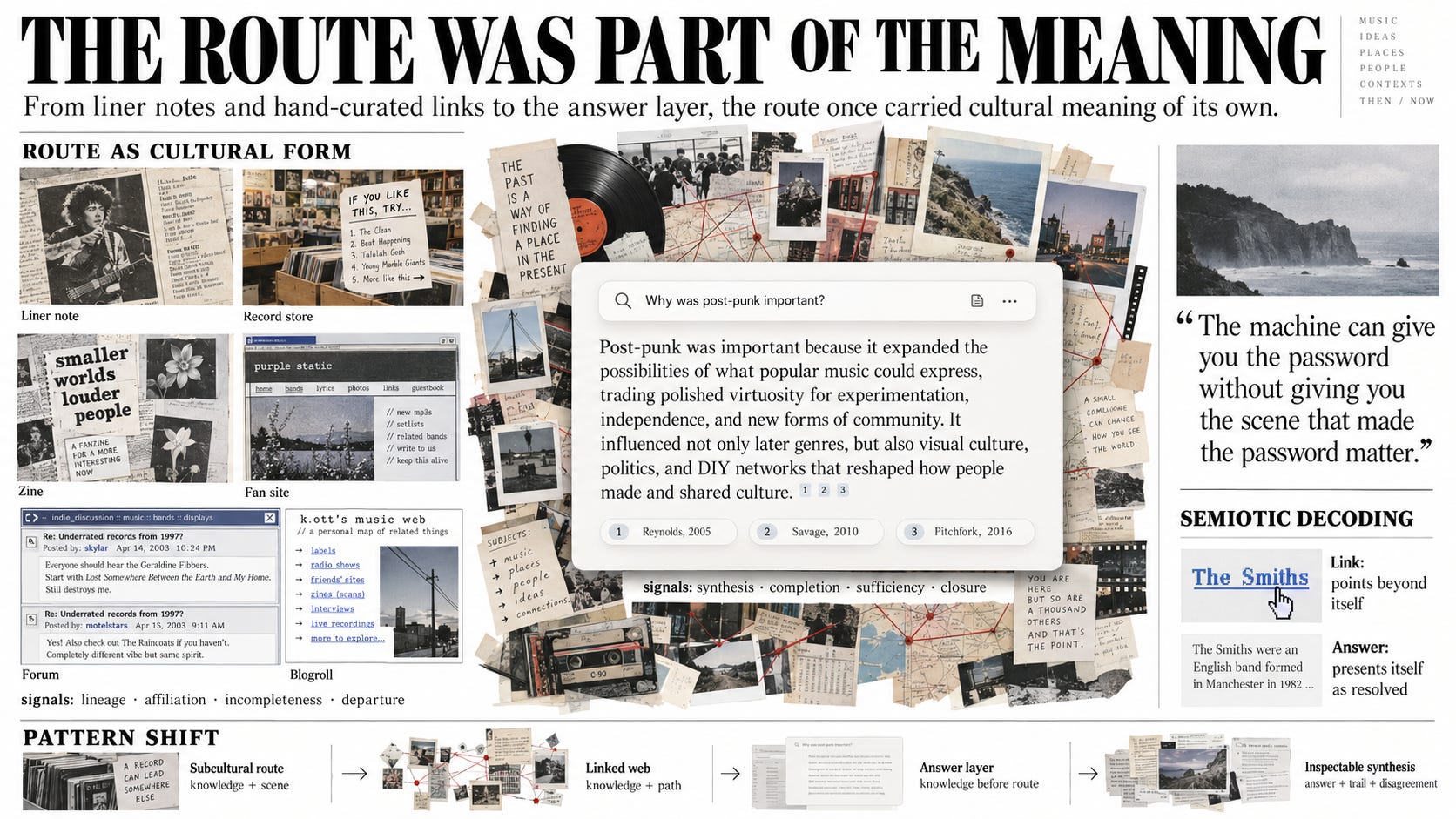
A generative answer often speaks in one voice, in a finished paragraph, with its sources gathered into small marks at the edge. Its form borrows the authority of the reference book. A list of results tells the reader that alternatives exist. A synthesized paragraph tells the reader that the comparison has already been made. The paragraph can be correct and still carry that message. A Pew Research Center browsing study from last year fits that reading: Google users clicked a traditional search link roughly half as often when an AI summary appeared. The study tracks where readers went next and says nothing about whether the summary was accurate.
The cost is easiest to see in material whose value a small group argued into existence. Record collectors have preserved histories around releases that barely sold, and fanzines have often championed bands before the larger music press paid attention. Klosterman gets at the stakes in the same interview. If a publication ever produced a list of the hundred greatest records and got it right, he says, it would be “the ultimate end of culture,” because culture would be “frozen to a point where we agree.” His book But What If We’re Wrong? rests on a related wager, that present certainty is provisional and later readers will rearrange it. Rearranging it depends on getting back to the material and to the arguments people made about it at the time.


Ask an AI about the experimental German music of the seventies, and it may hand you the word krautrock in seconds. The word works as a way in. British music writers helped popularize it, and many of the German musicians it grouped together disliked it and preferred other names for what they were making. An answer that supplies the term and leaves that dispute alone has handed the reader a password. There is a difference between receiving the password and entering the scene that made the password meaningful. Suppose these systems become better than search at surfacing the obscure record. That would be a gain. The record could still arrive without the argument that made anyone care about it.
Related Reading: Shibboleths in Branding Analyzing Trends, July 2025
A citation points to a source behind a sentence. Cultural provenance asks who connected two things, and against which reading they did it. An answer system could carry that kind of provenance by treating its sources as positions in an argument, with the people who disagreed kept beside the conclusion. Ask what krautrock is, and the answer arrives in seconds. Ask who named it and who objected, and you learn whether the route came with it.


