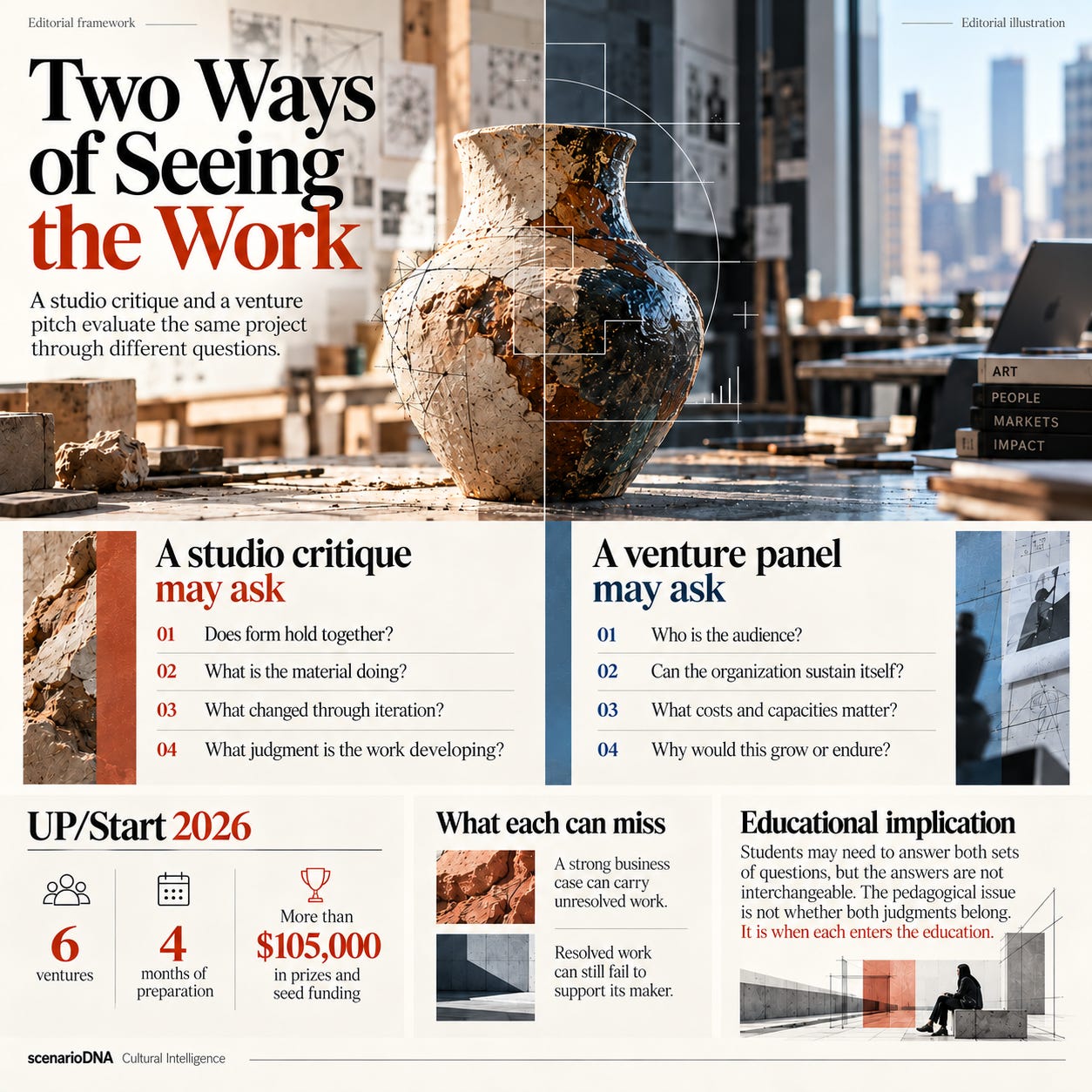
This April, six ventures led by students and recent alumni of the Maryland Institute College of Art presented their businesses to judges and an audience in Baltimore. They were competing for $105,000 in seed funding at the tenth annual UP/Start competition. The teams had spent four months developing their ventures before the pitch. One ceramics student hoped to take her studio global. The largest award went to an arts collective that stages exhibitions in the city’s underused spaces. The competition gives students money to continue their work. It also asks them to demonstrate something a studio critique does not: that the work can sustain an organization.
A venture panel decides whether a proposal deserves capital. A ceramics critique asks whether the form, surface and glaze work together. Students may need to answer both questions, but the answers are not interchangeable. A convincing business can sell unresolved work. Accomplished work can struggle to support its maker. An art school has to decide when each judgment belongs in the education.